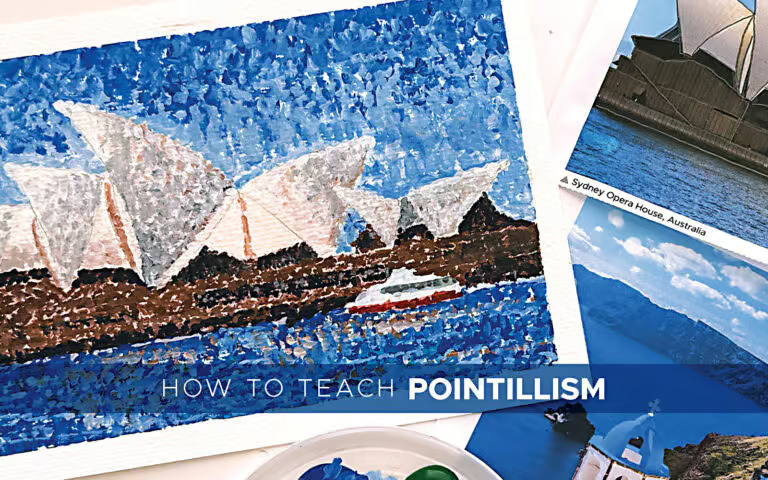
Pointillism is a great way for art students to explore how color, perception, and technique work together. Here is how to teach Pointillism, why I think it’s worth teaching, a brief biography of Georges Seurat – the master of the Pointillist technique, and how I use watercolor wash and acrylic dots to mimic optical color blending.
What Is Pointillism?
Pointillism is a painting technique in which small, distinct dots of pure color are placed next to each other so that they visually blend when viewed from a distance. Instead of mixing pigments on a palette, artists rely on optical mixing, letting the viewer’s eyes and brain combine the colors. For example, placing tiny blue and yellow dots near each other produces the perception of green—even though green paint was never used. The technique grew out of scientific color theory and the Impressionists’ interest in light, but it took the idea further by eliminating visible brushstrokes entirely.
Why Teach Pointillism?
Teaching pointillism benefits students in several ways. Pointillism provides color mixing opportunities both on the palette and optically. The technique is time-consuming but rewarding. It teaches attention to detail and the value of deliberate, thoughtful mark-making, while encouraging students to slow down and really take their time creating their artwork. It is also a great way to teach observational skills and how realism can be achieved by really studying the subject matter. Lastly, I love the variety in the outcomes of pointillism. Each of my students always has a different approach to dot-making, and the end results make quite diverse artworks, allowing their personal style to shine through.
Who is Georges Seurat?
Georges Seurat was a French Post-Impressionist painter best known for pioneering Pointillism, also called Neo-Impressionism. He became fascinated with scientific color theory, optics, and the physics of light. Seurat believed that painting could be approached systematically.
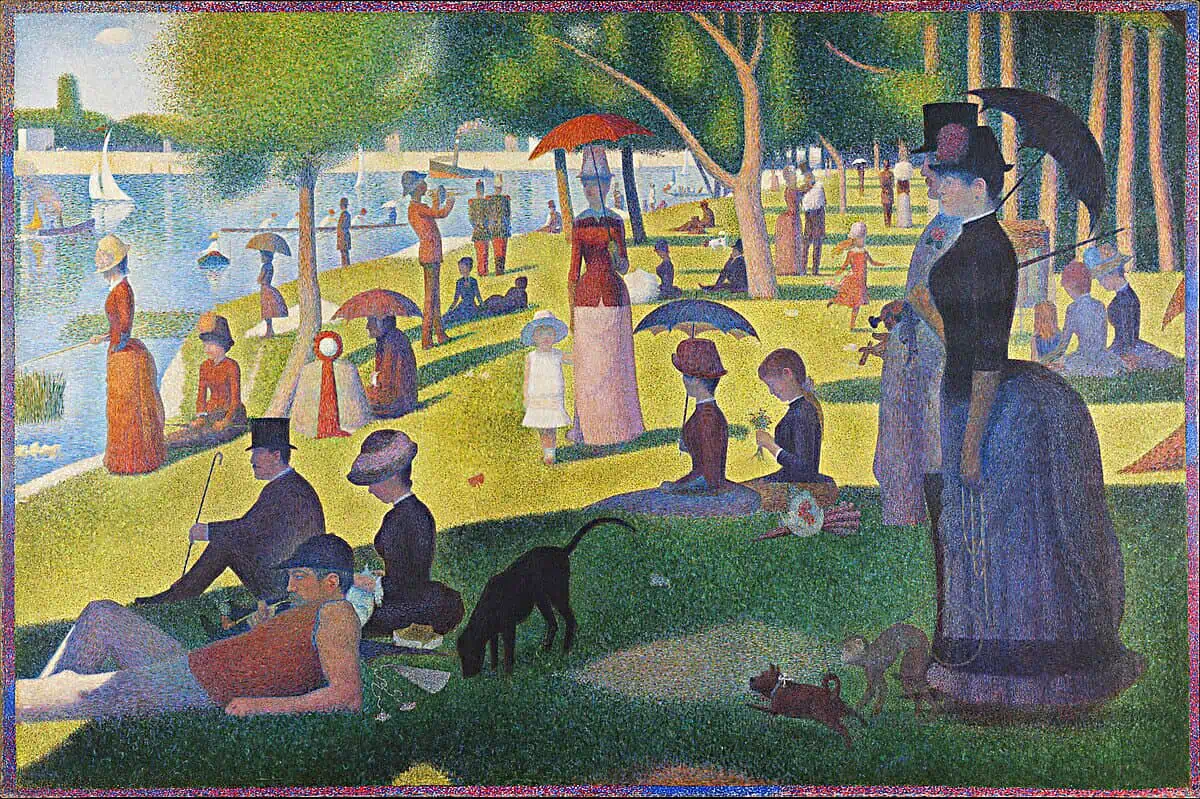
Instead of the loose brushwork of the Impressionists, he applied tiny dots of pure color carefully arranged for optical color mixing. He believed the human eye could mix the colors better than he could ever mix with his palette knife and paintbrush. His most iconic work, “A Sunday Afternoon on the Island of La Grande Jatte”, helped introduce Pointillism to the world and remains one of the most recognized paintings in Western art.
How I Teach Pointillism
My mixed-media approach to this technique allows students to explore both traditional color theory and Seurat-style optical blending, yet it is less time consuming. It’s great for middle school or high school. I encourage my students to choose a simple landscape or landmark. They begin with a light watercolor wash or gradient to create atmospheric depth. The watercolor serves as a base or underpainting, reducing the time it takes to fill every space with dots, yet still providing the students with the experience of seeing how color dots interact and mix optically.

Next, we use a variety of tools to create acrylic dots painted over the watercolor wash. Students use cotton swabs, toothpicks, wooden skewers, or small brushes to make small dots of acrylic paint. They mix colors, values, dot sizes and dot spacing to create different tones and values of the colors they see in their reference photo. This is another “trust the process” lesson, so I repeatedly encourage my students to step back frequently and see how the colors blend from a distance, which is a key part of experiencing Pointillism. The result is breathtaking!
I keep the size of the artwork small, calling them “Pointillism Postcards”. Due to the time-consuming nature of Pointillism, working small allows students the experience without the need to spend weeks on one painting or drawing. Index cards or half sheets of watercolor paper are the perfect size for this lesson. If time permits, I also ask my students to write a note on the back of their “postcard” describing the place they just painted.
My Pointillism art lesson is available here. It includes 34 ready to print reference photos of sights from around the world for student use.

Variation for Younger Students
I have also taught Pointillism using markers and a similar concept. Like the watercolor wash, students fill areas with a light-colored marker. Next, they use a darker marker to overlap dots in each area. For example, they fill in the shape of a pine tree with a light green color. Next, they use dark green dots to fill in the shape to create the dot pattern and create some visual mixing. This approach is easier, and less messy than the painting approach. Which makes it a perfect introduction for upper elementary or middle school students.
Not only does Pointillism introduce students to an influential technique pioneered by Georges Seurat but also deepens their understanding of how color, perception, and light interact. My students learn to look closer, think deeper, and paint with intention.
Thanks for Reading, Trista
If you liked this How to Teach Pointillism post, please subscribe by clicking here.
Check out my How To Page for more posts like this.