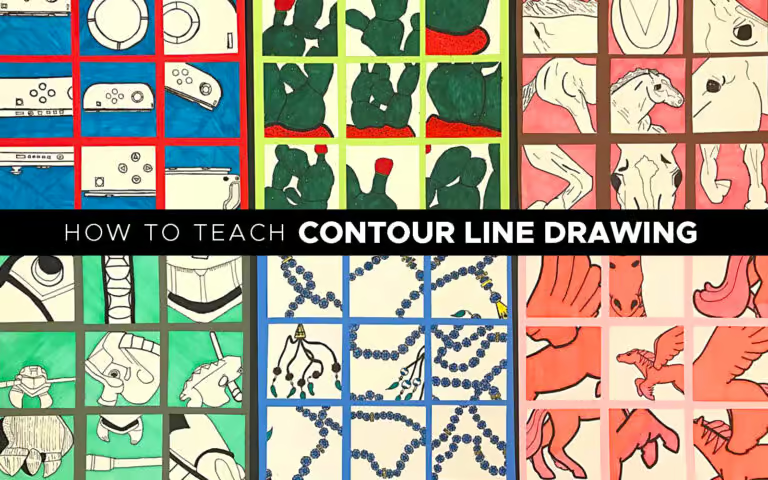
Developing contour line drawing skills is a great way to help your students become more confident at drawing. Before asking students to create detailed or realistic drawings, I like to spend time building the foundational skills that artists use to really see what they are drawing.
Blind Contour Exercise
I love introducing contour line through a series of quick, low-pressure drawing exercises such as blind contour drawing. They are a great way to get students thinking about contour. Have them draw any object nearby (a stapler, scissors or their own hand). They draw only the contour line of their subject but without looking at the paper. They will most likely find the results funny but it’s getting their minds to see the contours.
Continuous Line Drawing
Continuous line drawing is another great exercise where one unbroken line is used to create an entire drawing. The artist’s pen or pencil, or brush leaves the paper. Like the blind contour drawing, this can be done with any nearby object or a partner across the table.
Gesture Drawing Exercise
Gesture drawing is another favorite exercise of mine. Students draw a partner. One student strikes an action pose while the other student creates a quick, loose sketch that captures the movement, and pose rather than the details. I give students 60 seconds for each sketch and they take turns drawing each other.
These short warm-ups take only a few minutes but provide valuable practice with observation, building confidence with drawing, composition, and line quality. As students become more comfortable with these exercises, I gradually challenge them to think about how line weight, line variety, and composition can communicate more than just the outline of an object.
Nine Views Lesson
When ready to move on to a full art lesson, I love to do a contour line drawing lesson where students draw the same object from 9 different view. It challenges students to think about both composition and contour line. Students use viewfinders to isolate nine different compositions of a small subject matter of their choice, creating a different view in each of the nine sections. They draw using contour lines only, experimenting with a variety of line weights.
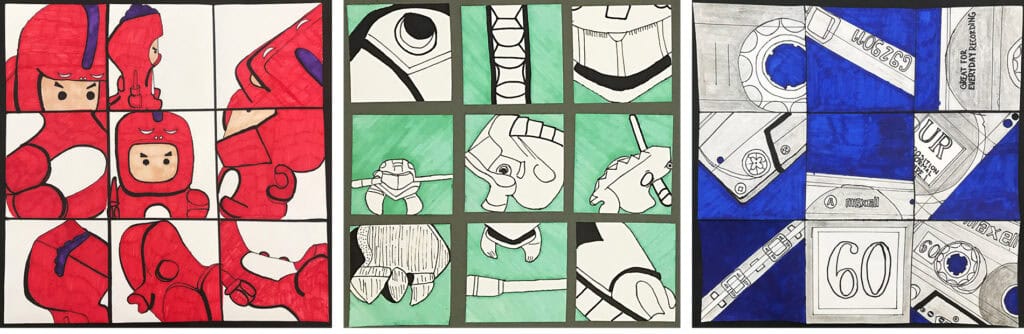
For example, ultra-fine lines are used to show detail while using heavier lines are used to draw attention to larger or more important areas. To take the project even further, students can add color to either the positive or negative space in each of the nine views. The result is a fun, cohesive composition that allows students to practice observation, cropping, line variation, emphasis, and positive and negative space—all while drawing the subject matter of their choice.

Check out my Nine Views Contour Line Drawing Lesson Here.
Weighted Contour Drawing
My other favorite line drawing lesson to teach is the Weighted Contour Line Still Life Drawing. I create a variety of small still life displays on trays, which makes it easy for each student to have a manageable composition to observe and draw. Students begin by drawing the objects using contour line only, carefully observing the shapes, overlaps, and details. Once their contour drawing is complete, we take it a step further by using a line to create the illusion of volume. Students use a tapered or implied line to suggest a highlight and a bold, heavier line to indicate a shadow. This teaches students that they don’t always need traditional shading or color to make an object appear three-dimensional. With thoughtful placement and variation in line weight, students can make their drawings feel much more dimensional.

My Weighted Contour Line Lesson is Available Here.
Next Steps
I believe these skills are the perfect starting point for any drawing curriculum or drawing unit. Before jumping into complicated techniques, I like to make sure students understand how to build drawings from basic shapes, consider composition, and use lines intentionally. From there, they can explore how line variety and line weight can create emphasis, depth, and volume—even without shading or color. These foundational skills give students a strong visual vocabulary and the confidence to approach almost any drawing challenge. Once students understand how to look, simplify, compose, and use line purposefully, they have the tools they need to grow throughout an entire drawing curriculum.
Thanks for Reading, Trista
If you liked this How to Teach Contour Line Drawing post, please subscribe by clicking here.
Check out my How To Page for more posts like this.