Teaching the art of observational drawing is less about producing perfect images and more about helping students learn how to truly see. Many of my beginning artists come into the art room believing that drawing is a talent you either have or don’t, but I believe observational drawing is a skill that can be learned. Each student can learn how to draw from observation by applying careful looking, patience, and practice.
Learning to Observe
A perfect starting point is to introduce simple, familiar objects and ask students to focus on what they notice rather than what they assume. When students observe closely, they begin to recognize subtle details: the way a contour line curves, how one shape overlaps another, or how light creates areas of highlight and shadow. Encouraging this kind of intentional looking helps students build visual awareness, which is the foundation of all observational drawings.
Learn How to See Shapes
As students begin drawing, it’s important to guide them in simplifying what they see into basic shapes. Breaking complex objects into circles, rectangles, and ovals makes the task feel more manageable and reduces frustration. From there, students can refine their drawings by comparing proportions and spatial relationships and adding more detail to the contour lines once the overall shapes and size have been fine-tuned. This stage reinforces that drawing is a process of constant adjustment rather than a one-time attempt.
Don’t Jump into Details Right Away
Another key aspect of teaching observational drawing is helping students resist the urge to jump straight into details. Young artists often want to focus on the most recognizable features right away but encouraging them to build their drawing gradually leads to stronger results. By lightly sketching the entire subject first and then slowly refining edges and adding details, students develop more balanced and accurate drawings. This approach also teaches patience and persistence, which are essential habits in any creative practice.
Learn Shading Techniques
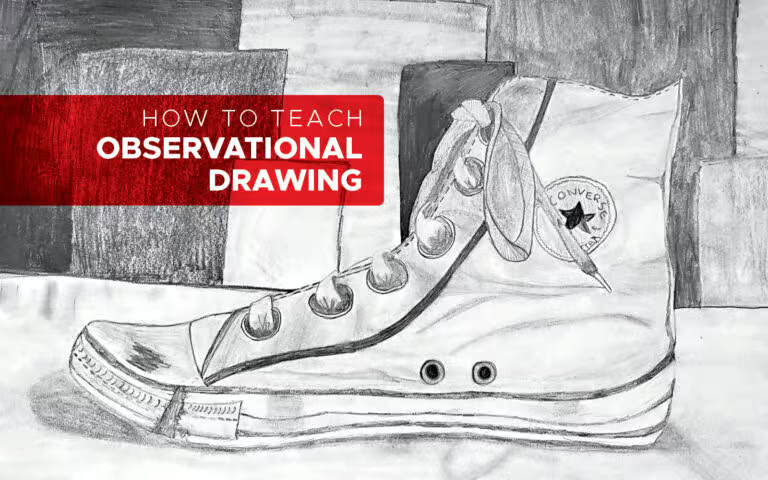
Finally, introducing shading allows students to bring depth and realism into their work. Teaching them to identify a light source and observe the full range of values—from highlights to deep shadows—helps them understand how form is created on a flat surface. Simple shading techniques, such as varying pencil pressure or basic hatching, can be enough to transform a flat drawing into something dimensional.

Throughout this process, it’s important to reinforce that success is not about perfection but about growth, observation, and effort. All of these techniques and skills are in my Observational Drawing and Value Study Art Lesson. This is always a student favorite and uses shoes, which are something every student has. My Observational Drawing Lesson is available here.

Lastly, when art teachers create a classroom environment that values curiosity and careful observation, students begin to see themselves as capable artists. Over time, they gain confidence as they realize that drawing is something they can learn step-by-step, simply by paying attention to what is right in front of them.
Thanks for Reading, Trista
You can watch my Observational Drawing YouTube Tutorial by clicking here.
If you liked this How to Teach Observational Drawing post, please subscribe by clicking here.
Check out my How To Page for more posts like this.